

Why we think differently…
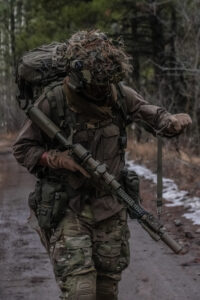
For far too long, modern militaries have poured resources into advanced technology. Airborne assets, precision munitions and AI systems, while the individual soldier and his load carriage equipment have largely been neglected. As a result, troops continue to carry increasingly heavier loads while using outdated designs that have changed little in decades, resulting in decreased combat effectiveness for the modern battlefield.
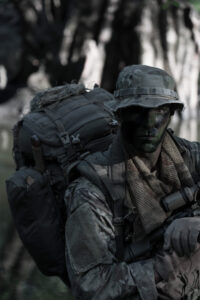
It’s time to change that. By combining proven biomechanics with a sound understanding of physiology, human performance and cutting-edge textile technologies, we offer a better way to equip soldiers. Our approach increases their effectiveness and efficiency on the battlefield, while protecting their musculoskeletal health and preserving their bodies for the long haul.
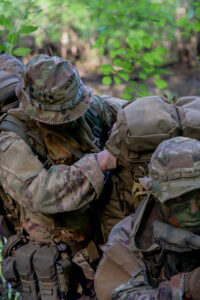
The Hidden Cost of Load Carraige: Why Traditional Rucksacks are Hindering Soldier Performance and Longevity…
Modern soldiers are carrying heavier loads than ever before, often exceeding 100 pounds during operations. While militaries focus heavily on weapons, armor, and tech, one critical factor which can be undervalued is how that load is carried and implemented effectively in the field. How good is the latest drone tech if it can’t be brought safely deep into the battlefield?
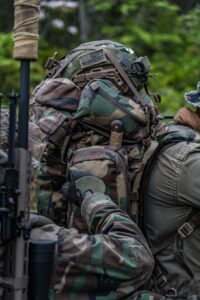
Research shows that using a properly designed pack which redirects force away from the spine and into the pelvis, can drastically reduce compressive forces throughout the upper body, therefore significantly decreasing pressure on the shoulders, lower back, and decreasing muscle fatigue. Multiple studies have found that the use of a proper hip belt and frame rated to the required load can reduce the compressive forces on the L5-S1 disc on average by 28% [Legg, 1985 Comparison of different methods of load carriage, Ergonomics, 28; Vacheron et al, 1999 Journal of Biomechanics; Stuart et al, 2013 Journal of Biomechanics]
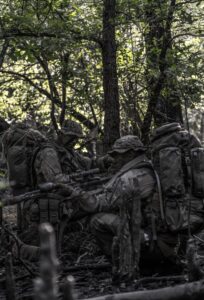
The same studies and others have also shown that a properly designed pack can reduce shoulder pressure by 28% and significantly lower incidences of thoracic outlet syndrome (TOS), and lower markers of rotator cuff acute damage and degeneration, tendonitis, impingement and early tears. A significant uptick in trapezius myalgia above 34% was shown in the group not using a proper hip belt. [Knapik, Orr, Pope, et al. Risk factors for musculoskeletal injuries in military recruits during basic combat training: a systematic review. American Journal of Preventative Medicine 2015].
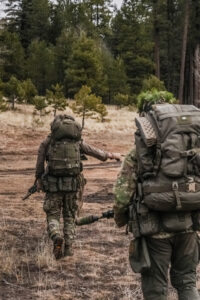
Additionally, proper load transfer to the hips has been shown to reduce metabolic fatigue by 14% during loaded marches and reduced shoulder girdle muscular fatigue by 25%. [Carmy, et al. 2017; Knapik, Reynolds, Harmon. Soldier load carriage: historical, physiological, biomechanical, and medical aspects. Military Medicine 2004; Teo, et al. 2022].
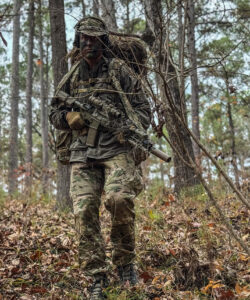
For anyone who has spent a good amount of time carrying a pack, this is a simple game changer. This not only improves comfort over long infill’s, but it decreases energy expenditure and can directly impact mission success. A soldier who arrives at the objective already physically exhausted cannot perform at full capacity. As we have seen time and time again, when soldiers carry heavy loads without proper load distribution, repetitive compressive stress is imposed upon structures of spine which cannot be conditioned to adapt, structures like the vertebral disks, particularly the lower lumber disks which can lead to serious spinal damage and chronic pain.
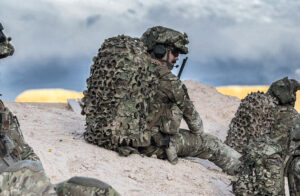
European militaries have traditionally relied on long-back alpinist style rucksacks adapted for military use. While effective for mountaineering, these designs fall short and create serious conflicts when paired with body armor and fighting loads. With their internal frames, they are unable to adequately support the weight beyond a typical hiker’s load. Simply put, they are using a car’s trunk, when they need a pickup truck with proper tires and suspension.
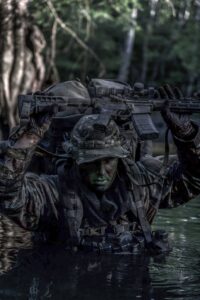
Secondarily, there is a major conflict with long back rucks. Soldiers are often forced to choose between proper lumbar support and carrying essential combat fighting equipment around their waist. A longback ruck requires the hip space, but the soldier is also required to carry their fighting load, this is one of the main reasons we have seen a major uptick in load related injuries over the last two decades. The challenge increases even further with the use of modern plate carriers due to compatibility issues and integrations between the combat load and the sustainment load.
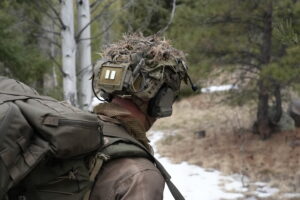
The consequences not only affect a soldier’s human performance on the battlefield, but can linger long after their service ends. Understandably, a soldier who arrives at the objective already physically exhausted cannot perform at full capacity. Unlike athletes, who can be substituted when fatigued. Soldiers don’t have that luxury and must maintain peak performance throughout the entire mission. This directly impacts mission success.
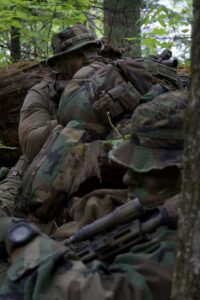
More importantly, the damage often follows soldiers long after their service ends. Many veterans face years of chronic pain and limited mobility, creating substantial ongoing costs for military healthcare systems and veteran care programs.

At Crossfire, this is where our design philosophy is fundamentally different. We spec all of our rucksacks to be used with a full fighting load while maintaining the ability to utilize a well-engineered frame and hip belt. Our packs are engineered with a precise cutout designed to mate cleanly with a standard plate carrier, eliminating hot spots and points of friction. Our designs result in a direct increase in lumbar stability, while redirecting force to the stronger legs and femurs and away from the upper torso; exactly the conditions these studies have measured, regardless of what fighting load is used.
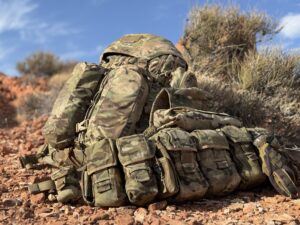
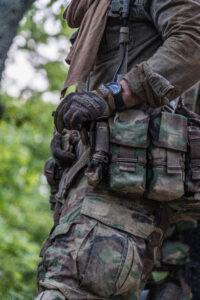
Taking it one step further, we have developed a completely new fighting belt (the DZ Rig). This system relocates a substantial amount of weight typically carried by the shoulders either in a plate carrier, chest rig, or rucksack and is now relocated directly around the waist. When used with our rucksacks, the DZ Rig can serve as the primary hip belt when in use. When paired with our rucksacks their original hip belts can be either strapped behind the pack or removed entirely. This allows the DZ Rig to take over the load transfer, something which is not possible with a typical gun belt or ammo belt. This design effectively shifts weight off of the shoulders, lowers the soldiers center of gravity and reduces forward lean and muscular fatigue over long movements.
A Complete Load Carraige Ecosystem
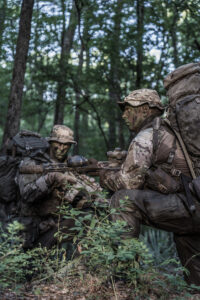
Several years ago, we identified limits in logistics and functionality when it came to load carriage. The tools used for carrying loads were too specific and weren’t able to easily adapt into multiple roles. Leaving soldiers in many situations trying to fit a square peg into a round hole. To address this issue, we began developing an entire ecosystem built to flex to the soldier’s load carriage needs.
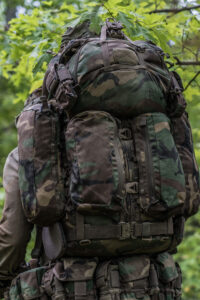
We designed at the center of this ecosystem our very own modular attachment technique known as LTAS (Ladder Toggle Attachment System). When it comes to large sustainment sized pouches, many would agree that MOLLE isn’t the best solution. It’s slow, cumbersome and considered to be semi-permanent. Once one has finished attaching or building out a rig it would typically remain in that configuration for long durations. In contrast, our LTAS system is truly modular. Our system allows the soldier to reconfigure their load in seconds, not hours.
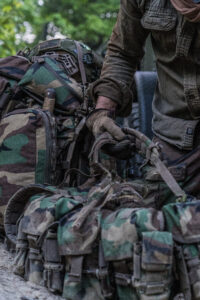
Our LTAS system now gives soldiers the ability to keep a suite of pre-packed pouches, containing ammunition, medical supplies, food or specialist gear. When preparing for a mission, they simply select the pouches needed for that day’s requirements and attach them externally to the pack in seconds.
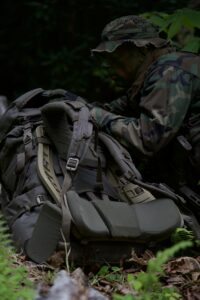
This modularity flows across our entire platform of our “CF-line” products. Rather than offering many “mission-specific” packs with large gaps in capacity, our ecosystem is designed like a visible light spectrum. Each packs capacity overlaps and blends into the next. This allows units to cover a full range from 15 liters to 130 liters, while using very few products. With the overlap of capacities, many missions can be accomplished with less gear, therefore keeping planning and logistics far simpler.
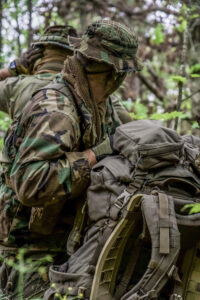
Building upon the ecosystem our DZ Rig allows the soldier to be able to carry a full fighting load of up to 12 magazines, 2 liters of water, medical, radios and optics in a fast ergonomic location around the waist, rather than stowed away in a pack. This design significantly improves the logistics and flexibility of infantry combat.
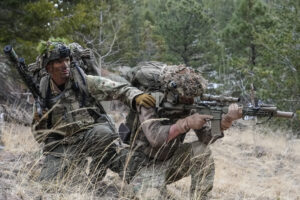
In situations where soldiers must drop their rucksack during a firefight and needs to move quickly, the DZ Rig ensures they remain fully armed and equipped. It gives soldiers the ability to be agile and highly maneuverable during direct action keeping them lethal and effective when it matters most.
The result is a complete and seamless load carriage ecosystem where every pouch, rig and pack is designed to work together. This approach doesn’t just simplify procurement and logistics; it gives soldiers equipment that truly supports both their immediate combat effectiveness and long-term health.
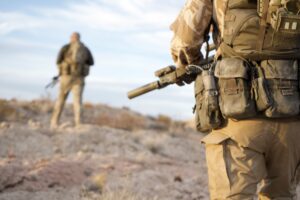
We don’t just build rucksacks; we have created a fundamentally better way to carry load into the field. One that keeps soldiers more capable and more effective on the battlefield, and healthier throughout their careers.